Can your business own AI-generated images? Understand human authorship, copyright registration, client contracts and creative-asset rights under U.S. law.
A marketing agency produces a new campaign with AI-generated visuals. A founder pays a freelancer to make product images using an image generator. A designer revises the output in Photoshop, arranges the components, and delivers finished files to a client. The work looks professional and the invoice is paid. But who actually owns the copyright?
The answer depends on the human authorship in the finished work and the contracts governing the project. Under the U.S. Copyright Office’s guidance, purely AI-generated expressive material generally is not protected by copyright merely because someone supplied prompts. Identifiable human-created expression, creative modifications, or sufficiently original selection and arrangement may be protected, subject to the ordinary rules.
This matters for brands, creators, agencies and entrepreneurs across California: a right to use an AI service is not necessarily the same as owning an enforceable copyright in every pixel it produces.
Copyright protects original works of authorship fixed in a tangible medium—such as photographs, illustrations, writing and certain audiovisual material. It protects original expression, not a general idea, a style, a business concept or a familiar design element.
The U.S. Copyright Office explains the basic originality and fixation requirements. The distinction matters with generative AI because human involvement can occur at several stages: conception, prompting, selection, editing, compositing and final design. Not every contribution amounts to protected authorship.
For example, the idea of “a golden sunset behind a luxury product” is not itself copyrightable. Original human-created imagery, illustration, arrangement or modifications used to express that concept might be.
The Copyright Office’s January 2025 Copyright and Artificial Intelligence report, Part 2 explains that prompts by themselves generally do not provide the necessary human control over the expressive elements of a generative AI output under the Office’s analysis of then-current technology.
This does not mean prompting is unimportant commercially. A carefully developed prompt may require skill and judgment, but a creative process and a copyrightable expression are not always the same thing. The key question is which protectable choices the human actually determined in the final work.
Similarly, selecting the “best” of several generated options does not automatically make every generated visual element human-authored. The Office evaluates claims in a fact-specific way, considering the actual material for which copyright is asserted.
Consider three different workflows:
The practical lesson is not that a particular percentage of manual editing makes a work copyrightable. There is no simple “edit 20%” rule. The nature and originality of the human contribution—not an arbitrary amount of effort—are central.
Potentially, if the claim properly identifies copyrightable human authorship. The Copyright Office’s AI registration guidance says applicants must disclose material generated by AI and identify the human-authored contribution being claimed when appropriate. Applicants should not present purely AI-generated content as though it was independently authored by a person.
A finished brand campaign may contain separately protectable human-created photography, copy, graphic composition or modifications alongside unprotectable generated imagery. The application should accurately describe the protectable content and exclude material outside the claim as instructed by the Office.
Registration decisions can be technical. An inaccurate application may create problems later, especially when a business tries to enforce rights against a competitor.
Not automatically. Payment and copyright ownership are separate issues. A written contract can address assignment of the creator’s transferable rights, permitted uses, delivery of working files, warranties and obligations relating to third-party materials. Whether a contribution qualifies as a “work made for hire” is governed by specific federal requirements; simply labeling a freelancer relationship that way does not settle every situation.
For an AI-assisted deliverable, the contract should not promise exclusive ownership of material the contractor cannot legally own or transfer. Instead, parties should identify the human-authored material, any third-party licensed assets, AI tool terms, confidentiality conditions and limitations on exclusivity.
For background, see Work for Hire vs. Copyright Assignment: Who Actually Owns the Work?
A platform’s terms may permit some forms of use or impose restrictions. Those contractual permissions are distinct from whether copyright subsists in the output.
An output may resemble existing protected expression or contain third-party material. Lack of copyright in your own output does not automatically eliminate the risk of infringing another person’s rights.
Copyright and trademark rules serve different purposes. An AI-created design that cannot be copyrighted might still raise trademark clearance questions when used as a brand identifier.
An agency that guarantees every AI output is exclusive, original and risk-free may assume contractual obligations it cannot realistically verify. Agreements should accurately describe review, permitted uses, limitations and responsibility for obtaining clearance.
Before a business launches an AI-assisted campaign, the following process can reduce avoidable uncertainty:
The goal is not to make marketing teams stop using AI. It is to give the business an accurate picture of what rights it can rely on when the campaign succeeds.
Businesses do not need to choose between adopting new creative technology and taking intellectual property seriously. What they need is a documented process that distinguishes owned material, licensed material, human authorship and unresolved rights.
For a brand launch, agency contract, copyright registration question or potential infringement dispute, Lum Law Group can discuss the issues and appropriate next steps.
Official sources: U.S. Copyright Office AI Initiative and Part 2 Report; What Is Copyright?; Copyright Office AI Registration Guidance Announcement.
Editorial: Draft prepared November 17, 2026; attorney verification required before publication. General legal information only; not an assurance of copyright registration or freedom from infringement.
Learn how the relevant legal requirements may affect your situation. A consultation is an opportunity to discuss your specific questions and next steps.
Under the Copyright Office’s current approach, purely AI-generated expressive material generally lacks the required human authorship. Identifiable original human-created contributions may be separately protectable.
Time and effort are not, by themselves, substitutes for legally sufficient human control over the expressive elements. The actual creative contribution is evaluated case by case.
Commercial use depends on tool terms, third-party rights, contracts and the specific artwork. An output’s lack of copyright protection does not automatically make every commercial use lawful.
Trademark protection turns on different legal requirements, including use as a source identifier and avoidance of conflicting rights. See Can You Trademark an AI-Generated Logo? for a separate discussion.
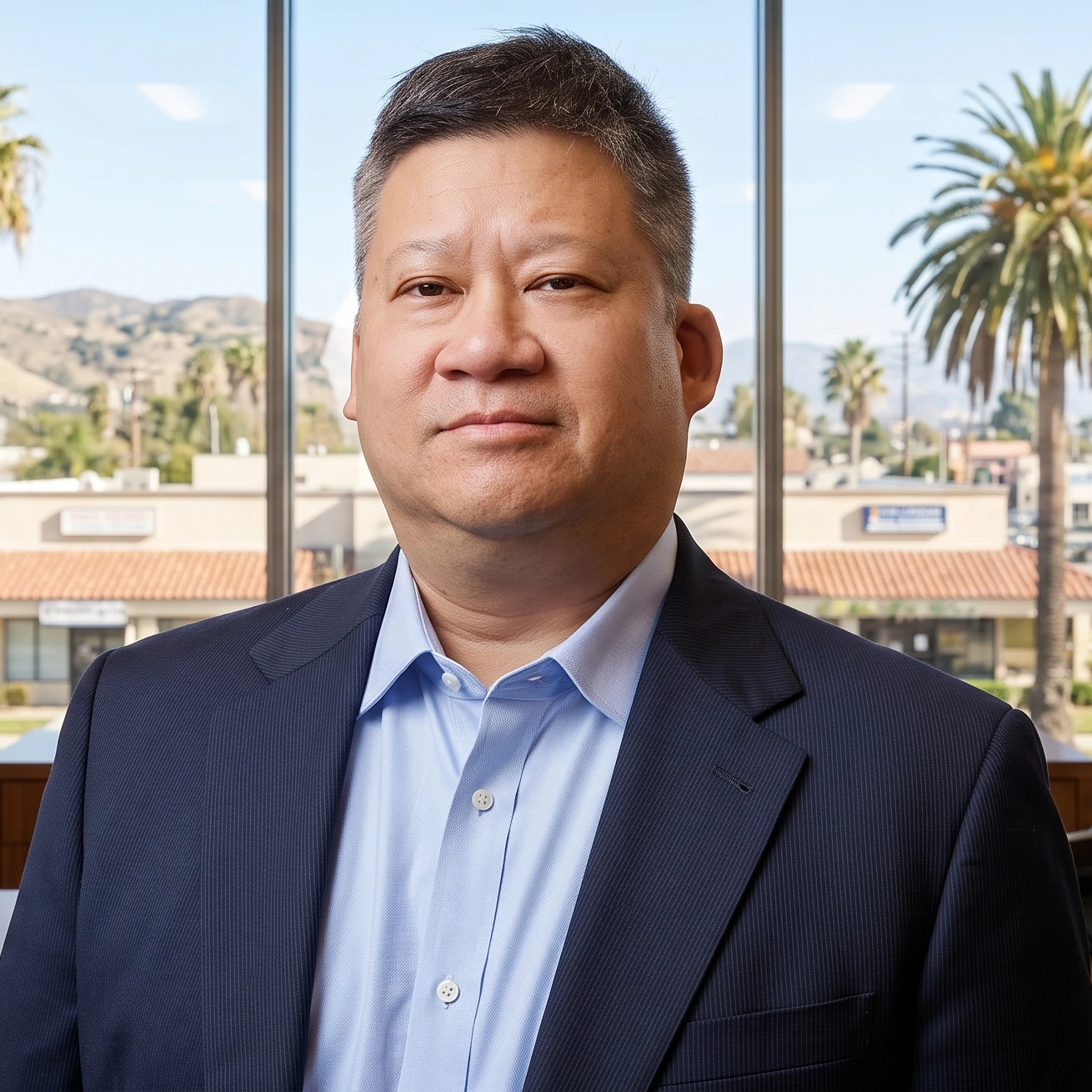
A. Justin Lum has been practicing law since 1993, with more than 30 years of experience serving clients across a wide range of legal matters. A graduate of the University of California, Berkeley and UC Davis School of Law, he is also a past President of the Southern California Chinese Lawyers Association, continuing a proud family legacy of leadership in the legal profession.